Artist Marketing Ideas That Actually Work in 2026

Artist Marketing Ideas That Actually Work in 2026

I photograph paintings for a living, which means I spend a lot of time talking with artists about their marketing ideas. I see what works, what gets abandoned after two weeks, and what quietly compounds into something real over years. These are the marketing moves I’ve actually watched move the needle — for my clients, and for myself.

My first client, Minneapolis painter Joe Paquet, has been making the case for authentic self-promotion for over a decade. He gives a lecture on authenticity. He lives it. He has 56,000 Instagram followers and sells paintings priced from $2,500 to $50,000. His approach isn’t a hack or a formula. It’s consistent, genuine, and specific to who he is as an artist. Everything on this page is built around that same philosophy.

Your Email List Is Your Most Valuable Asset

Every other platform on this page is rented space. Social media algorithms change. Platforms rise and fall. But an email list is yours. No algorithm stands between you and the people who have already said yes to you.

Start with a free account on Mailchimp — free up to 500 contacts and easy to use. If you want a platform that also helps new readers discover your writing organically, Substack is worth a look. Either way, start collecting emails now.

Where to collect them:

  • Add a signup form to your website — above the fold if possible
  • Collect at every art fair, open studio, and show — a simple clipboard works
  • Add a link to your email signature
  • Mention it when you post to social media

Send updates a few times a year: new work, upcoming shows, process notes, or something genuinely useful to your collectors. Keep it honest and short. The goal is to stay present in their lives, not to sell in every email.

I send my own newsletter about once a month to over 1,700 artists and art lovers in the Twin Cities. Here’s a sample.

Free Artist Marketing: Complete Your Event Directory Listing

If you’re showing at Art-A-Whirl, Art Attack!, the Saint Paul Art Crawl, or any juried fair, your event directory listing is your best free marketing opportunity — and most artists leave it half-finished.

These events are already being promoted to people actively planning to attend. That’s an audience of motivated buyers who are looking for you. A blank listing, or one with a blurry phone photo, is a missed connection with someone who was already on their way.

What a strong listing includes:

  • A high-quality, representative image of your work — not a booth shot, not a selfie
  • A short bio that tells people who you are, not just what medium you use
  • Your website and social links
  • Studio number and location clearly stated

The image is the most important element. People forget names. They remember images. Your listing photo is how they’ll find you again when they’re searching through hundreds of artists the following week.

Google Business Profile — The Invisible SEO Lever

A free Google Business Profile puts your studio on Google Maps, shows your hours and contact information, and gives collectors another way to find you in local search results. Most artists don’t have one. Even fewer post to it regularly.

Here’s what I’ve noticed from my own profile: Google consistently rewards posting activity with improved local search visibility — even when it looks like nobody is reading those posts. The mechanism is real, even if the audience is invisible. A weekly or biweekly post takes two minutes and costs nothing.

Setup takes about ten minutes:

  • Go to google.com/business and create a listing
  • Enter your studio address, hours, website, and photos
  • Google will mail a postcard with a verification code — enter it to activate the listing
  • Once verified, post regularly: new work, show announcements, anything you’re also posting elsewhere

The same content you’re posting to Instagram can go here with a two-minute copy-paste. Make it a habit.

The Social Media Shotgun — A Repeatable Workflow

The most common mistake I see artists make on social media is treating every platform like it needs a completely separate strategy. It doesn’t. Create the content once. Distribute it intelligently.

Here’s the workflow I use for my own business and recommend to my clients:

  1. Send your newsletter first. Your email subscribers are your most committed audience. They earned early access.
  2. Wait two to three days, then post across social platforms in sequence. This avoids self-competition in feeds and staggers your engagement window.
  3. Post the same content across platforms, adjusting tone slightly for each — but don’t start from scratch.

Instagram

Joe Paquet’s Instagram is proof that traditional painting and serious Instagram presence are not in conflict. 56,000 followers built through consistent, authentic posting over years.

The algorithm changed fundamentally around 2022. Hashtags are much less important than they used to be — the platform now prioritizes content signals: saves, shares, time spent on post, and overall account consistency. What still works:

  • Post consistently — three times a week is better than seven erratic posts
  • Reels get more initial reach than static posts, but a strong static image has longer shelf life
  • Use 5–10 focused, relevant hashtags instead of 30 generic ones
  • Stories work well for process shots, studio life, and behind-the-scenes moments
  • Write captions that say something real — Joe’s captions are about seeing, not selling

Facebook

Organic reach has declined significantly for most business pages, but Facebook isn’t gone — the audience is just different. Personal profile posts reach your warm audience better than page posts. Facebook Events work well for show openings and open studios. Groups are where real community engagement lives now — look for local collector groups, artist communities, and neighborhood art networks.

Keep your business page active for legitimacy and so you have the option to run targeted boosted posts when you have something worth promoting, like a show or a print sale.

LinkedIn

Underrated and almost universally ignored by visual artists. Corporate collectors, interior designers, gallery directors, and commercial clients are on LinkedIn — and they’re not scrolling Instagram. A professional framing of your work reaches a buying audience the other platforms don’t touch. If you do corporate commissions, gallery work, or sell to businesses, LinkedIn is worth a consistent presence.

Google Business Posts

Post the same content you’re posting elsewhere. Even if nobody reads it, Google rewards the activity with improved local ranking. Takes two minutes. Don’t skip it.

Flickr

Legacy SEO value that most people have forgotten about. Flickr has strong domain authority and its images get indexed by Google Images. Before I focused on artwork photography, I spent years as a high-profile Minneapolis street photographer under the name Mitchster. That old Flickr account still ranks prominently in search results for my name — free, ongoing visibility from work I did years ago. Legacy SEO is real. If you have an existing Flickr presence, maintain it. If you don’t, it’s worth setting up.

Pinterest

Think of Pinterest as a visual search engine, not a social media platform. Pins link back to your website and remain active for months — not hours like Instagram posts. For visual artists, this is one of the highest-leverage free tools available precisely because the content has a long shelf life.

I pin my clients’ artwork with artist credit and a link to their portfolio page on my site. It’s good for their visibility, good for my site’s internal linking, and good for both of us in search results. You can do the same with your own work — each pin should link back to a page on your website where collectors can learn more or get in touch.

AI for Artists — An Honest Conversation

A lot of artists are skeptical of AI right now, and I understand why. The concern is usually about AI-generated imagery — the slop flooding social feeds, the devaluation of skill, the blurring of authorship. Those are legitimate concerns worth taking seriously.

But there are two completely separate conversations happening under the same “AI” label. One is about AI as an art-making tool. The other is about AI as a business operations tool. This section is entirely about the second one — and it’s no different in principle from using Photoshop, Google Docs, or a spreadsheet.

I use Claude, made by Anthropic. If you’ve followed AI news, Anthropic made headlines recently for refusing to allow Claude to be used for autonomous weapons or domestic surveillance — a principled stand that cost them a significant government contract. For artists who care about ethics in technology, that context is worth knowing.

Ways artists are using AI tools right now for their business:

  • Writing and editing artist statements — give Claude your notes and ask it to shape them into a polished statement in your voice
  • Drafting newsletter copy — describe what you want to share and ask for a draft to edit
  • Writing platform-specific social media captions — one painting, multiple platform-appropriate descriptions
  • Researching upcoming art competitions and fairs (there’s even a page on this site for that: Art Competitions for Minneapolis Artists)
  • Editing website copy for clarity and SEO
  • Brainstorming titles and descriptions for new work

The key to working effectively with AI: it’s collaborative, not a vending machine. The more specific context you give it — your voice, your style, your audience, your goals — the better the output. Iterate. Push back on what doesn’t sound like you. Treat it like a very fast, very patient research and writing assistant that needs good direction.

Sample prompt for platform-specific painting descriptions

Copy this and adapt it every time you post new work:

“I have a new painting to post across several social platforms. Here are the details: Title: [title]. Artist: [your name]. Medium: [medium]. Size: [dimensions]. Subject and mood: [brief description of what the painting shows and feels like]. My website link is [URL]. Please write separate descriptions optimized for: Instagram (visual and emotional, around 150 words, include 8 relevant hashtags), Facebook (conversational and slightly longer, good for sharing), LinkedIn (professional tone, collector-focused), Pinterest (search-optimized, descriptive, keyword-rich), and Google Business Post (brief, local, includes my city).”

Why Your Phone Is Lying About Your Paintings

Kevin Komadina brought me his painting Road Trip and showed me the photo his iPhone had taken of it. Something looked deeply wrong. The colors had shifted, the values were compressed, and the painting on his screen looked like a different piece than the one in front of me. He asked me what the phone was doing.

That question sent me down a deep research rabbit hole. Here’s what’s actually happening inside your phone when you photograph a painting:

  • Auto-exposure compensation: The camera reads bright areas and darkens them down, assuming they’re overexposed. A painting of a luminous sky gets crushed to gray because the phone thinks it’s correcting a blown-out photograph of an actual sky.
  • Auto-white balance: The camera shifts color temperature away from what your pigments actually look like. Warm lights get cooler. Cool shadows get warmer. The carefully built color relationships in your painting get quietly rearranged.
  • HDR processing: The phone stacks multiple exposures and synthesizes artificial contrast. Your considered value structure gets reinterpreted by an algorithm designed to make vacation photos look punchy.
  • Portrait mode edge detection: If portrait mode is active, the blur algorithm reads textured paint surfaces as “background” and softens them. Impasto loses its character. Glazing layers flatten out.
  • AI scene recognition: The phone identifies the subject — “landscape,” “sunset,” “interior” — and applies processing presets designed for capturing real scenes, not for faithfully reproducing a painting of one. The painting gets processed as if it were the thing it depicts.

The result is a painting that looks nothing like itself. For competition submissions, this means jurors are evaluating a different painting than the one you made. For print sales, it means the file won’t reproduce your colors faithfully. For your online portfolio, it means collectors form inaccurate expectations before they ever see your work in person.

Accurate documentation of your artwork is a professional skill, not just better equipment. I trained as a color separator — that was a real job, once — and I work as a trained artist who understands pigment chemistry, how different painting mediums respond to light, the color palettes of plein air traditions, and atelier techniques. Every painting I photograph gets color-corrected to match the original, not to match what a camera algorithm thinks it should look like.

See what professional artwork photography includes and costs →

Selling Prints Opens a Second Market

There are collectors who want original art. They care about provenance, about owning something unique, about the physical object a human hand made. There’s also a completely separate group of people who simply love an image — they want to wake up and see it on their wall, and they’re not in a position to spend $3,000 on an original.

These are not competing markets. They’re parallel ones. Offering prints doesn’t cannibalize original sales. It opens access to buyers who would never have purchased an original in the first place.

The prerequisite for quality prints is a quality photograph. Prints made from phone photos reveal every weakness — color inaccuracy, compression artifacts, lack of resolution — at the scale of a canvas print. The file needs to be right before the print can be right.

More on how to increase your artwork sales by offering prints →

Consider Getting Dedicated Help

You make the work. You don’t have to build the entire infrastructure around it by yourself.

Nanci Fulmek is an equestrian painter and one of my clients. She also teaches artists how to turn their work into sustainable income. Her course Turn Your Art Into Cash is built around the practical, unglamorous work of actually selling. If you’re serious about treating your art as a business, it’s worth your time.

Professional artwork photography is another form of dedicated help — specialized, one-time work that pays dividends across every use case: competition submissions, print sales, gallery applications, your website, and social media. You do it once, and it works for you for years.

See pricing and what’s included →

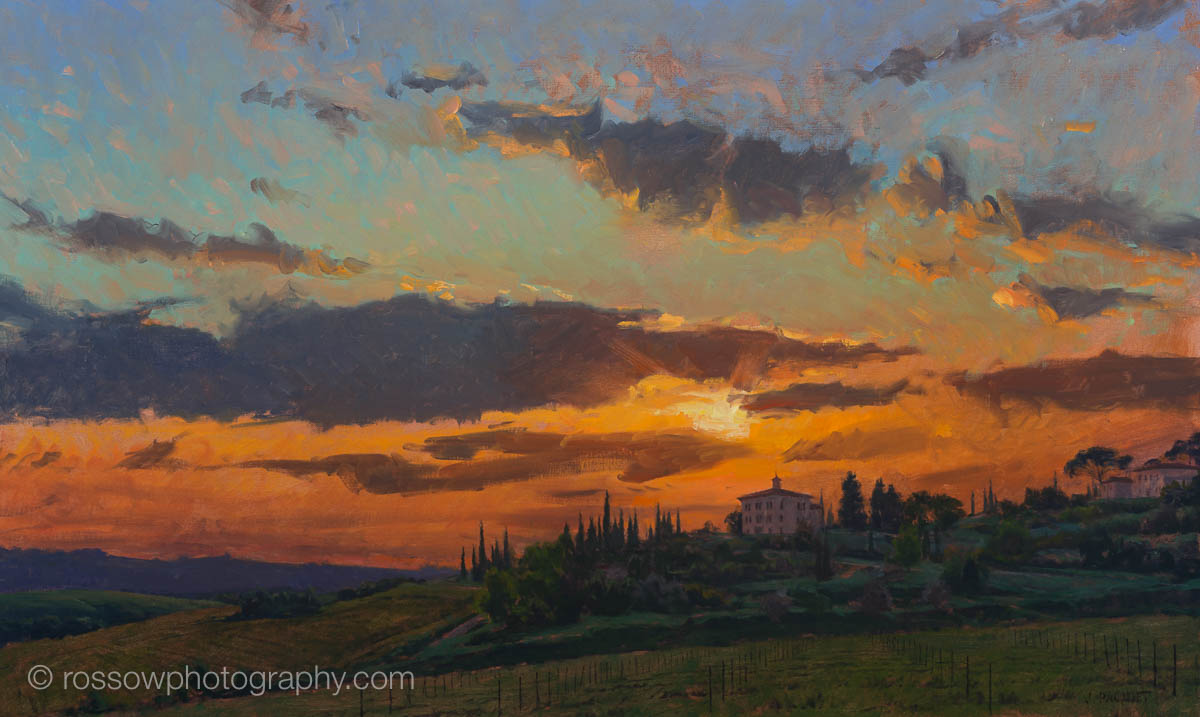
Featured image Sunset, Tuscany 30×50 by Joe Paquet