
Photography vs. Scanning: Choosing the Right Method for Your Artwork
Photography vs. Scanning: Both professional photography and professional scanning far outperform a phone camera, and both are legitimate ways to reproduce your work. The right choice isn’t about which method is better in general, it’s about which one fits the piece in front of you. Here’s an honest breakdown to help you figure that out before you book anything.
When Scanning Is the Better Choice
Scanning tends to win for flat, dimensionless work: prints, drawings on paper, and flat watercolors without texture. If your giclée printer specifically requests a scan file rather than a photograph, that’s worth listening to, they know their own printing process. Scanning also only works within the size of the scanner bed itself; the largest professional flatbeds handle roughly up to 46×70 inches, so anything bigger needs another approach regardless of preference.
When Photography Is the Better Choice
Photography is the right call whenever a piece has real dimension, an unusual surface, or can’t safely make contact with glass.
- Textured surfaces: canvas, impasto, palette knife work, pastel on board, anything with real dimension that a flat scan would compress.
- Unusual mediums: tile, textile, knit work, collage, maps, crop art, and anything else that can’t lie flat under scanner glass.
- Gold leaf and other reflective or iridescent work: these rely on light traveling across the whole surface at a consistent angle to read correctly. A scanner’s fixed internal light source can’t reproduce that; it takes the kind of directional, controllable lighting only a camera setup provides.
- Paintings with a vignette effect (the image fading gradually into the background rather than holding a hard edge): scanners often introduce visible banding across that kind of smooth gradient, and photography’s global capture handles this better.
- Wet paintings: photography never touches the surface, so a piece that’s still wet, fresh off the easel from a plein air session, recently signed, or rushed straight from the studio to make a competition deadline, can be photographed safely. A scanner requires direct contact with glass, which wet paint can’t survive. Oil paintings in particular can take a long time to fully dry.
- Work larger than scanner capacity, and multiple pieces documented in one sitting, which is usually more economical per piece at volume.
One Thing to Tell Me if Your Painting Is Still Wet
I normally give every painting a careful surface clean before photographing it, removing dust and any stray fuzz. That’s exactly the kind of thing you don’t want done to a piece that hasn’t cured yet, so just let me know ahead of time if what you’re bringing in is still wet. I’ll skip that step for that piece and handle it accordingly.
What About the Uneven Lighting Problem?
The standard critique of photography over scanning (hot spots, vignetting, uneven illumination) is a real concern, but it’s a critique of general photographers, not of a studio built specifically for artwork reproduction. Custom lighting rooted in a process camera heritage achieves the same even, controlled illumination a professional scanner provides, without glass, without a size ceiling, and with a trained human eye doing the color correction on a full RAW file rather than automated scanning software making that call on its own.
Photography vs. Scanning: Not Sure Which Is Right for Your Work?
Unusual or challenging pieces are a specialty here, not a problem to work around. If you’re not sure which method fits what you have, a quick phone call is usually enough to sort it out, often before you even bring anything in. Call or text 612-702-9571, or contact me here. If photography turns out to be the right fit, here’s how that process works, and pricing is laid out here.
More resources for Twin Cities artists are on the Artist Resources page.
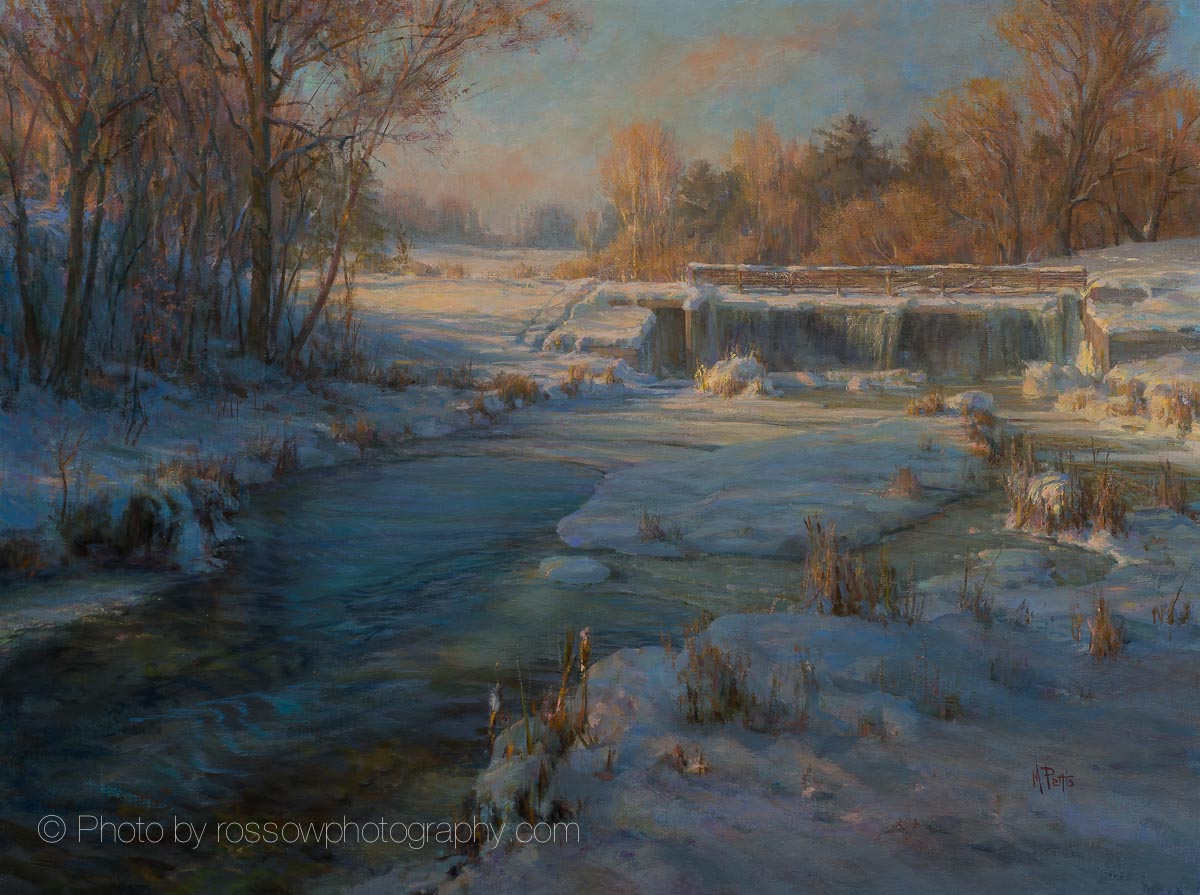
* Featured image above: Winter Sun at the Mill Site 24 x 34 by Mary Pettis